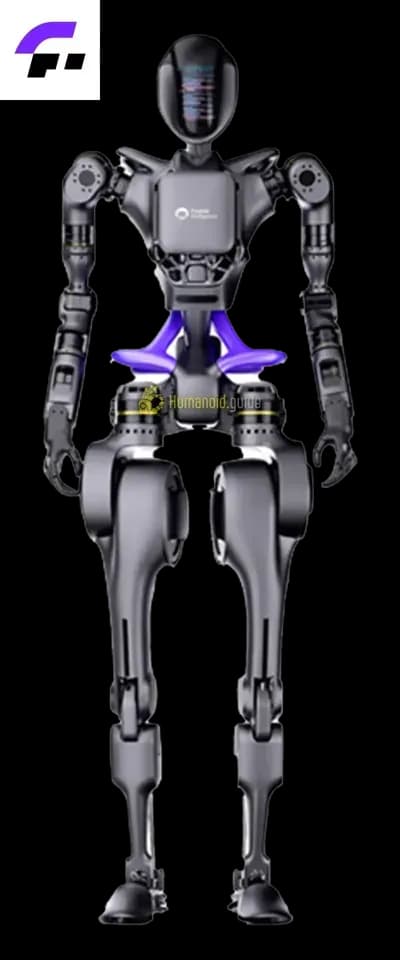
Aucune photo officielle disponible — image de substitution.
Abandonné🇨🇳 China
GR-1
par Fourier Intelligence · humanoid · Annoncé 2023 · Livré 2023
~$150,000–$170,000 historically; discontinued and replaced by GR-2 (2024) and GR-3 (2025)
China's first mass-produced humanoid with near-bodyweight carry capacity (50 kg) for research and industrial use.
Aperçu
Le GR-1 est un humanoid développé par Fourier Intelligence (China), annoncé en 2023 (en livraison depuis 2023). Il a été abandonné. Avec 165 cm de haut, 55 kg, 40 degrés de liberté, peut transporter des charges jusqu'à 50 kg. Points forts : vitesse maximale de 1.39 m/s, autonomie de 60 minutes. La plateforme offre processeur NVIDIA Isaac Lab ecosystem, compatible ROS1, équipé de Stereo cameras, IMU, force-torque sensors.
Caractéristiques
Taille
165 cm
Poids
55 kg
DDL
40
Charge utile
50 kg
Autonomie
1h
Vitesse max.
1.39 m/s
Batterie
—
Temps de charge
—
Escaliers
Oui
LiDAR
Non
Calcul
NVIDIA Isaac Lab ecosystem
ROS
ROS1
Plateforme
Capteurs
Stereo camerasIMUforce-torque sensors
Système d'exploitation
ROSNVIDIA Isaac LabMuJoCo
Dernière mise à jour: 2026-09-26 · Annoncé 2023 · Livré 2023
Sources
- fftai.com/products-gr1vérifié 2026-09-26
- europasatellite.com/Fourier-GR1.htm2026-09-26
- blog.robozaps.com/b/fourier-gr1-review2026-09-26
- en.wikipedia.org/wiki/Fourier_(company)vérifié 2026-09-26
FAQ
Q.Quel est le prix du GR-1 ?
Le prix du GR-1 n'a pas encore été officiellement annoncé.
Q.Quelles sont les caractéristiques du GR-1 ?
Le GR-1 dispose de : 40 DOF, 165cm, 55kg, 50kg payload, 60 min runtime. NVIDIA Isaac Lab ecosystem, ROS1.
Q.Le GR-1 est-il disponible à l'achat ?
Le GR-1 a été arrêté.
Q.Who makes GR-1?
GR-1 is made by Fourier Intelligence, headquartered in China. Official manufacturer site: https://www.fftai.com/products-gr1.
Q.Does GR-1 support ROS?
Yes. GR-1 supports ROS1, which makes it compatible with the broader Robot Operating System ecosystem and tooling.
Q.How long does the GR-1 battery last?
GR-1 runs for approximately 1h on a single charge.
Q.What payload can GR-1 carry?
GR-1 is rated to carry up to 50 kg of payload, suitable for industrial logistics and warehouse workloads.
Q.How fast is GR-1?
GR-1 has a published maximum walking speed of 1.39 m/s and can navigate stairs.
Q.What are alternatives to GR-1?
Closest specs-wise alternatives to GR-1 include Phoenix by Sanctuary AI, MenteeBot V3 by Mentee Robotics, Forerunner K1 by Kepler Robotics. Full head-to-head comparison: https://biorobot.ai/fr/vs/sanctuary-phoenix-vs-fourier-gr1.
Comparer GR-1
GR-1 vs PhoenixSanctuary AIGR-1 vs MenteeBot V3Mentee RoboticsGR-1 vs Forerunner K1Kepler RoboticsGR-1 vs A2AgiBot (Zhiyuan Robotics)
All 37 comparisons with GR-1
GR-1 vs 4NE-1GR-1 vs A2GR-1 vs ApolloGR-1 vs Astribot S1GR-1 vs Atlas (Electric)GR-1 vs CyberOneGR-1 vs DigitGR-1 vs DR02GR-1 vs Figure 03GR-1 vs Forerunner K1GR-1 vs Forerunner K2GR-1 vs G1GR-1 vs G1GR-1 vs GR-2GR-1 vs H1GR-1 vs H1-2GR-1 vs H2GR-1 vs Kaleido 9GR-1 vs L7GR-1 vs MenteeBot V3GR-1 vs MirokaiGR-1 vs NAO V6GR-1 vs NEOGR-1 vs Optimus Gen 2GR-1 vs Optimus Gen 3GR-1 vs PhoenixGR-1 vs PM01GR-1 vs R1GR-1 vs RAISE A1GR-1 vs Reachy 2GR-1 vs SE01GR-1 vs SophiaGR-1 vs T-HR3GR-1 vs T1GR-1 vs TALOSGR-1 vs Walker SGR-1 vs Walker S2