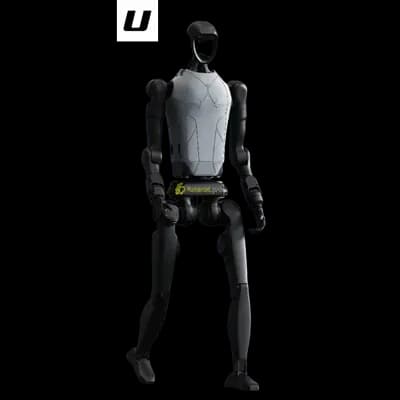
Discontinued🇨🇳 China
H1-2
by Unitree Robotics · humanoid · Announced 2024 · Shipped 2024
$99,900
$99,900–$128,900 (last distributor prices); delisted from the Unitree store in 2026, sold out at distributors; succeeded by H2 ($29,900) / H2 Plus ($100,000)
Upgraded H1 with 7-DOF arms for enhanced manipulation and 21 kg payload capacity.
Overview
The H1-2 is a humanoid developed by Unitree Robotics (China), first announced in 2024 (shipping since 2024). It has been discontinued. Standing 178 cm tall, weighing 70 kg, with 27 degrees of freedom, it can carry payloads up to 21 kg. Performance highlights include a top speed of 2 m/s, a battery runtime of 120 minutes, a 864 Wh battery pack. The platform is powered by Intel i5 + Intel i7; optional NVIDIA Jetson Orin NX, ROS2 compatible, equipped with Intel RealSense depth camera, Livox MID-360 LiDAR, IMU. Pricing starts at $99,900 ($99,900–$128,900 (last distributor prices); delisted from the Unitree store in 2026, sold out at distributors; succeeded by H2 ($29,900) / H2 Plus ($100,000)).
H1-2 — use cases
Manipulation-focused research where H1 was underpowered
Original H1 shipped with 4-DOF arms rated for ~5 kg lift and stalled on any pick-and-place heavier than a stapler. H1-2 raised rated arm payload to 21 kg per side and added a full 7-DOF arm — matching adult human range of motion. Labs at CMU, MIT, Stanford, ETH Zurich, and Tsinghua re-purchased into H1-2 for contact-rich manipulation and warehouse-style bin transfer. Published work covers bin-pick, box-stack, and door-through walking — categories H1 could not touch. The Robot Report tracked 40+ university H1-2 orders by end of Q1 2025.
Foundation-model data collection at adult body proportions
Skild AI, 1X, and stealth groups bought H1-2 for whole-body motion data targeting adult-scale production hardware. G1 at 127 cm forced post-processing to correct proportion mismatch; H1-2 at 178 cm matches Figure, Apptronik Apollo, and Tesla Optimus envelopes. Manufacturer has not disclosed buyer names, but distributors confirmed multiple 10+ unit orders through 2025. Buyers frequently add the dexterous hand option for hand-scale motion capture.
Dexterous demos with 3-finger hands option
The $128,900 configured H1-2 adds Unitree's 3-finger dexterous hands (7 DOF each, ~20 DOF added system-wide). Published demos cover tabletop assembly, single-arm door opening, cup pouring, and light bimanual manipulation. Hand-scale sim-to-real transfer stays uneven, matching G1 EDU behavior — locomotion policies transfer reliably, contact-rich hand policies need on-hardware fine-tuning.
Loco-manipulation and walk-and-carry
H1-2 became the practical Unitree platform for whole-body loco-manipulation — arms strong enough to carry a real payload while walking. Published 2025 work includes walking-with-tray demos, box-carry between rooms, and door-through with tool in hand. Frontier problem for humanoid RL: locomotion RL and manipulation RL individually work, combining them under load does not. H1-2 was the shipping platform where labs actually tested combined policies; delisted from the Unitree store in 2026 and succeeded by the H2, it lives on in the installed base.
Commercial demo fleets at distributor level
Unitree distributors upgraded rental fleets from H1 to H1-2 through late 2024 for bookings expecting manipulation, not just walking. Day rates $5,000-$9,000 depending on region and operator. Bookings cover trade shows, marketing shoots, and product launches. H1-2 has not shipped into commercial production duty at any warehouse or factory customer, per Unitree.
Version history
H1-2 initial launch — August 2024
27 DOF, 178 cm, 70 kg, starting price $99,900. Ships with 7-DOF arms per side (up from H1's 4), 21 kg rated arm payload, dual Intel i5 + i7 compute with optional Jetson Orin NX. Sensor stack (Livox MID-360, RealSense) matches H1 EDU. Unitree explicitly positioned H1-2 alongside the original H1 rather than as a replacement — H1 stays cheaper for locomotion research, H1-2 targets manipulation labs.
Dexterous hands configuration — October 2024
3-finger dexterous hands option pushed configured price to $128,900. Each hand adds 7 DOF, bringing total system DOF over 40 in the fully-optioned build. Targets manipulation-oriented research and foundation-model data collection. Hand controllers ship as a Unitree first-party module rather than a third-party retrofit.
ROS2 parity with H1 — Q4 2024
First-party ROS2 Humble packages inherited from H1 and G1 rollouts. Coverage: joint-state, IMU, LiDAR, depth topics, plus URDF and Gazebo/Isaac Sim descriptions. H1-2-specific URDFs shipped through Unitree GitHub. Third-party MuJoCo Playground added H1-2 model in Q1 2025.
Firmware 2.1 — loco-manipulation baseline — Q1 2025
Firmware update added a manipulation-aware balance controller — sustained walking with a 5 kg arm load without gait destabilization. Rough-terrain gait remained at 2.0 m/s sustained. Unitree did not publish a sprint controller — the extra mass from arms and torso rules out H1's 3.3 m/s record on H1-2 hardware.
Loco-manipulation benchmark inclusion — Ongoing through 2026
By early 2026 H1-2 appears in CMU StaRLING-Manip, Stanford Sim2Real-Manip, and Unitree's own Playground manipulation benchmarks. Locomotion RL transfers reliably; loco-manipulation transfer improved from Q4 2024 baselines but remains the hardest sim-to-real category on the platform.
Deployment evidence
Unitree HQ — Hangzhou, China
Primary R&D and demo facility. H1-2 launch footage, manipulation demos, and firmware 2.1 validation runs originate here. Internal fleet size not disclosed.
Source: https://www.unitree.com/h1/
University manipulation labs — global
40+ H1-2 units shipped into university labs through Q1 2025, per The Robot Report. Named institutions include CMU, MIT, Stanford, ETH Zurich, Tsinghua Advanced Robotics. Most orders come from labs upgrading from H1 or adding H1-2 alongside G1.
Source: https://www.therobotreport.com/
Foundation-model data-collection fleets
Skild AI, 1X, and stealth-stage groups placed multiple 10+ unit H1-2 orders through 2025 per distributor confirmations. Buyer identities and fleet sizes not released. Adult-scale body proportions make H1-2 the preferred Unitree platform for foundation-model motion data.
Source: https://www.unitree.com/
Distributor demo and rental fleets
Unitree USA (San Diego), Europe (Frankfurt), and Japan operate rotating H1-2 demo units. Day rates $5,000-$9,000 including operator. Replaced H1 as the primary demo unit for manipulation-oriented bookings through late 2024.
Source: https://www.unitreerobotics.eu/
Known limitations
70 kg mass creates indoor safety envelope
H1-2 weighs 70 kg — 23 kg more than H1 and heavy enough that an unplanned fall around bystanders is a real safety incident. Universities enforce operator-only clearance zones and a fall-arrest tether during dynamic trials. Contrast G1's 35 kg envelope where crash-and-recover is an equipment problem, not a safety incident.
Speed drops from H1's record to 2.0 m/s
H1 held a 3.3 m/s sustained-run record. H1-2's added arm and torso mass rule out the same envelope — Unitree has not published a sprint controller and has explicitly said the mechanical envelope does not support one at 70 kg. Sustained walking sits at 2.0 m/s. Locomotion-only research groups stayed on H1 or moved to G1 rather than take the H1-2 speed hit.
Runtime drops under manipulation load
864 Wh battery matches H1 — but H1-2 pulls significantly more power under arm load. Nominal 120-minute runtime shortens to 60-80 minutes during sustained manipulation trials per lab feedback. No hot-swap. Continuous shift work stays outside the design envelope.
No IP rating, no outdoor duty
H1-2 is not IP-rated. Rain, snow, dust, sub-freezing operation outside spec. All published outdoor footage runs on dry pavement in mild weather. Manufacturer has not disclosed a weatherproofed SKU.
Successor risk on multi-year amortization
H2 rumors circulated through late 2025 and internal BiorobotAI tracker residuals put H1-2 at 65% after year one, falling to 30% by year three. Buyers financing over 3+ years should price faster depreciation than the $99,900 headline suggests.
How H1-2 compares
vs. Unitree H1
Same Unitree SDK2, same ROS2 packages, same sensor stack in top configurations. H1 keeps the 3.3 m/s sustained-run record; H1-2 loses it to the extra mass. H1-2 gains 7-DOF arms, 21 kg payload, and adult-scale manipulation envelope. Labs picking between them ask whether their study is locomotion-primary (H1 is cheaper and faster) or manipulation-primary (H1-2 is the only option). Unitree sells both in parallel through 2026.
vs. Fourier GR-1
Chinese adult-scale manipulation humanoid at 165 cm, 55 kg, 40 DOF. Fourier ships its own SDK and does not have Unitree's ROS2 first-party ecosystem or the university-lab footprint that Unitree built through 2024-2025. GR-1 has stronger integrated hand dexterity out of the box. H1-2 wins on ecosystem maturity, tooling, and community — GR-1 wins on DOF count and hand hardware at similar price.
vs. Agility Digit
Digit ships into commercial warehouses (GXO, Amazon pilots) as Robots-as-a-Service at ~$30/hr. Different segment from H1-2's research and data-collection sales. Digit's digitigrade legs, self-charging battery, and ISO 13482 certification target 24/7 industrial duty; H1-2 targets research where openness and sensor stack matter more than certification. Buyers picking between them are asking whether the problem is a research study or a shipping warehouse workflow.
Specifications
Height
178 cm
Weight
70 kg
DOF
27
Payload
21 kg
Runtime
2h
Max Speed
2 m/s
Battery
864 Wh
Charge Time
—
Stairs
Yes
LiDAR
Yes
Compute
Intel i5 + Intel i7; optional NVIDIA Jetson Orin NX
ROS
ROS2
Platform
Sensors
Intel RealSense depth cameraLivox MID-360 LiDARIMU
Operating System
Unitree SDK2 (C++, Python)
Last updated: 2026-09-26 · Announced 2024 · Shipped 2024
Sources
- unitree.com/h1verified 2026-09-26
- shop.unitree.com/collections/humanoid-robot2026-09-26
- blog.robozaps.com/b/unitree-h1-review2026-07-17
- humanoid.guide/product/h1-2verified 2026-09-26
FAQ
Q.What is the price of H1-2?
The H1-2 is priced at $99,900 USD. $99,900–$128,900 (last distributor prices); delisted from the Unitree store in 2026, sold out at distributors; succeeded by H2 ($29,900) / H2 Plus ($100,000)
Q.What are the specs of H1-2?
H1-2 features 27 DOF, 178cm, 70kg, 21kg payload, 120 min runtime. Intel i5 + Intel i7; optional NVIDIA Jetson Orin NX, ROS2.
Q.Is H1-2 available to buy?
H1-2 has been discontinued.
Q.Who makes H1-2?
H1-2 is made by Unitree Robotics, headquartered in China. Official manufacturer site: https://www.unitree.com/h1/.
Q.Does H1-2 support ROS?
Yes. H1-2 supports ROS2, which makes it compatible with the broader Robot Operating System ecosystem and tooling.
Q.How long does the H1-2 battery last?
H1-2 runs for approximately 2h on a single charge (battery capacity: 864 Wh).
Q.What payload can H1-2 carry?
H1-2 is rated to carry up to 21 kg of payload, suitable for industrial logistics and warehouse workloads.
Q.How fast is H1-2?
H1-2 has a published maximum walking speed of 2 m/s and can navigate stairs.
Q.What are alternatives to H1-2?
Closest specs-wise alternatives to H1-2 include A2 by AgiBot (Zhiyuan Robotics), 4NE-1 by NEURA Robotics, Digit by Agility Robotics (Amazon). Full head-to-head comparison: https://biorobot.ai/en/vs/unitree-h1-2-vs-agibot-a2.
Compare H1-2
H1-2 vs A2AgiBot (Zhiyuan Robotics)H1-2 vs 4NE-1NEURA RoboticsH1-2 vs DigitAgility Robotics (Amazon)H1-2 vs Walker S2UBTECH Robotics
All 32 comparisons with H1-2
H1-2 vs 4NE-1H1-2 vs A2H1-2 vs ApolloH1-2 vs Astribot S1H1-2 vs Atlas (Electric)H1-2 vs CyberOneH1-2 vs DigitH1-2 vs DR02H1-2 vs Figure 03H1-2 vs Forerunner K1H1-2 vs Forerunner K2H1-2 vs G1H1-2 vs G1H1-2 vs GR-1H1-2 vs GR-2H1-2 vs H1H1-2 vs H2H1-2 vs Kaleido 9H1-2 vs L7H1-2 vs MenteeBot V3H1-2 vs MirokaiH1-2 vs Optimus Gen 2H1-2 vs Optimus Gen 3H1-2 vs PhoenixH1-2 vs R1H1-2 vs RAISE A1H1-2 vs Reachy 2H1-2 vs SophiaH1-2 vs T-HR3H1-2 vs T1H1-2 vs Walker SH1-2 vs Walker S2