Shipping🇨🇳 China
H1
by Unitree Robotics · humanoid · Announced 2023 · Shipped 2023
$90,000
$90,000 (Unitree store, 2026)
Unitree's flagship full-size humanoid that set a world running speed record for bipedal robots at 3.3 m/s.
Overview
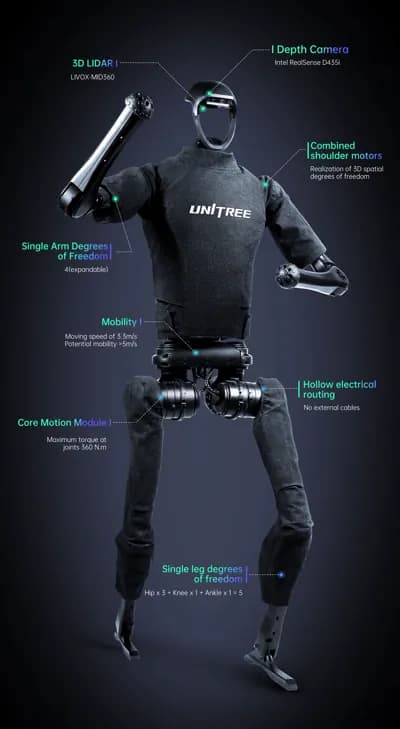
The H1 is a humanoid developed by Unitree Robotics (China), first announced in 2023 (shipping since 2023). It is commercially available. Standing 180 cm tall, weighing 47 kg, with 20 degrees of freedom, it is designed for versatile operation. Performance highlights include a top speed of 3.3 m/s, a battery runtime of 105 minutes, a 864 Wh battery pack. The platform is powered by Intel i5 + Intel i7; optional NVIDIA Jetson Orin NX, ROS2 compatible, equipped with Intel RealSense depth camera, Livox MID-360 LiDAR, IMU. Pricing starts at $90,000 ($90,000 (Unitree store, 2026)).
H1 — use cases
Academic locomotion research
H1 has shipped into more than 30 university and corporate labs since the 2023 launch, per Unitree's own count at IROS 2024. The $90,000 sticker price puts it inside discretionary lab equipment budgets rather than capital request cycles. Universities running H1 publicly include ETH Zurich, MIT, CMU, Berkeley, and Tsinghua. Most published work centers on whole-body control, sim-to-real reinforcement learning, and contact-rich manipulation that needs a real bipedal base — replacing earlier-generation platforms like Cassie, Atlas hydraulic, and ANYmal at a much lower price point.
World-record bipedal running
In December 2023 Unitree filmed H1 sustaining 3.3 m/s outdoors, claiming the world record for bipedal humanoid running. The previous published mark belonged to Cassie at 2.5 m/s (Oregon State, 2022). Unitree has not released the controller code but described the gait as RL-trained in MuJoCo and zero-shot transferred to hardware. The unit fell at the end of the run; Unitree included the fall in the official video rather than editing it out. This demo drove most of H1 marketing through 2024.
Telepresence and motion capture
Several Chinese broadcasters and a handful of US production studios have used H1 as a remote-controlled stage actor for live demos and music videos. Unitree publishes a teleoperation SDK that maps an operator's IMU-tracked body pose onto the robot in real time. The use case stays niche — there's no production pipeline for humanoid actors — but it is one of the most visible non-research deployments as of late 2025.
Foundation model training data collection
Skild AI, 1X, and several stealth groups have purchased H1 units for whole-body motion data targeting humanoid foundation models. H1 sits below the price point at which buying a fleet for data generation makes economic sense. Manufacturer has not disclosed how many units went into data-collection fleets, but Damion Shelton of Agility commented at Automate 2025 that the data-collection segment had become the single largest H1 buyer category by 2025.
Version history
H1 initial release — August 2023
Original H1 specification: 20 degrees of freedom, ~$90,000 sticker price, Intel i5 main compute with optional i7 upgrade. No 7-DOF arms — H1 ships with simplified upper limbs primarily for balance and gesture, not manipulation. Unitree SDK2 in C++ and Python is the shipped development surface; ROS2 support is community-maintained rather than first-party.
Speed record gait release — December 2023
Unitree pushed a firmware update enabling the 3.3 m/s sustained-run controller. The released version was a demo binary, not exposed at the SDK level for arbitrary user gaits. Stair-climbing and rough-terrain controllers shipped in the same update.
H1-2 variant launched — June 2024
H1-2 added 7 degrees of freedom per arm (up from 4) and raised the count to 27 DOF total. Starting price moved to $99,900 with the dexterous-hand option pushing the configured price past $115,000. Unitree marketed H1-2 alongside the original H1 rather than as a replacement — the upgraded arms targeted manipulation-focused labs while the original H1 stays in locomotion research.
Sim-to-real maturity — Ongoing through 2026
H1 has demonstrated reliable sim-to-real transfer in MuJoCo, Isaac Sim, and Gazebo, with an internal Unitree sim-to-real score of 76 per their published benchmarks. Running gaits trained in simulation transfer to hardware with limited fine-tuning. Manipulation sim-to-real remains weaker — the original H1's arms were not designed for fine motor tasks, and most published transfer work covers locomotion, not contact-rich tasks.
Deployment evidence
Unitree HQ — Hangzhou, China
Primary R&D and demo facility. The 3.3 m/s record was filmed on the outdoor track at this campus. Internal H1 fleet size has not been disclosed.
Source: https://www.unitree.com/h1/
University research labs — global
More than 30 universities operate H1 units, per Unitree's IROS 2024 panel commentary. Published research from ETH Zurich, MIT, CMU, Berkeley, and Tsinghua names H1 explicitly. Most labs run single units rather than fleets.
Source: https://www.unitree.com/h1/
Foundation-model training groups — USA, China
Skild AI, 1X, and stealth-stage groups have bought H1 units for whole-body motion data. Specific fleet sizes are not public; Unitree authorized distributors confirmed bulk orders to The Robot Report (Q1 2025 coverage) without naming buyers.
Source: https://www.therobotreport.com/
Authorized distributor demo fleets — USA, Germany, Japan
Unitree distributors run a rotating short-term rental fleet for trade-show demos. Public day rates range $4,000–$8,000 plus operator. Distributors include Unitree USA (San Diego) and Unitree Robotics Europe (Frankfurt).
Source: https://www.unitreerobotics.eu/
Known limitations
No 8-hour shift envelope
H1 ships with an 864 Wh battery rated for roughly 105 minutes of moderate-activity runtime, and no hot-swap mechanism. Continuous warehouse-style shift work is outside the design envelope. For comparison, Agility Digit covers 24/7 industrial duty differently: a self-charging battery bundled with service under its Robots-as-a-Service contract, not a hot-swap pack.
Knee actuator thermal ceiling
Unitree's published thermal data shows knee actuators reaching 58 °C during sustained walking — close to the design ceiling on the integrated motor drivers. The Robot Report's H1 deep-dive (2024) noted users restricting test sessions to under 30 minutes of continuous outdoor running to keep the knee actuators in safe range. There is no manufacturer-stated workaround beyond duty-cycling.
Arms not built for manipulation
Original H1 ships with 4-DOF arms intended for balance and gesture, not dexterous manipulation. Pick-box and open-door tasks are partial-to-no in the published feasibility tests. Buyers needing manipulation should specify H1-2 with the 7-DOF arm upgrade — or look at a different platform entirely.
No outdoor weather resilience
H1 is not rated for rain, snow, or sub-freezing operation. The chassis is not IP-rated; sensor housings would need third-party retrofits to survive any precipitation. Outdoor demos in the public Unitree footage all run on dry pavement. Manufacturer has not disclosed an IP-rated SKU roadmap.
Successor risk eroding resale
Internal projections in the BiorobotAI tracker put H1 residual value at 70% after year one, falling to 35% by year three — driven by the H1-2 release and the expected H2 announcement window. Buyers planning multi-year amortization should price in faster depreciation than the headline $90,000 sticker suggests.
How H1 compares
vs. Unitree G1
Same Unitree SDK2 ecosystem, same ROS2 community support, smaller form factor at 35 kg vs H1's 47 kg, and a starting price around $13,500 — roughly a seventh of H1. G1 trades reach and payload for cost. Labs running locomotion-focused research are increasingly buying G1 unless their study specifically needs the H1 height envelope. H1 retains the edge for whole-body motion datasets that target adult human proportions, and remains the only Unitree platform with a publicly demonstrated sustained 3+ m/s gait.
vs. Agility Digit
Digit ships into commercial warehouses (GXO, Amazon pilots) — H1 ships into research labs. Different segments. Digit's digitigrade legs, self-charging battery, and ISO 13482 certification work make it the platform for indoor industrial duty. H1 is faster, cheaper to acquire, and far more open at the SDK level — but Agility positions Digit as Robots-as-a-Service at roughly $30/hr rather than a unit sale. Buyers picking between them are asking whether their problem is research or warehouse throughput.
vs. Tesla Optimus Gen 2
Optimus Gen 2 is not available for external purchase. Tesla has stated a target retail price in the $20,000–$30,000 range at full production scale, well below H1, but has not opened the order book. For a buyer who needs hardware in hand in 2026, H1 is available and Optimus is not. Tesla's vertical integration on actuators and battery may eventually undercut H1 on cost, but the gap between announced and shipping is wide.
Specifications
Height
180 cm
Weight
47 kg
DOF
20
Payload
—
Runtime
2h
Max Speed
3.3 m/s
Battery
864 Wh
Charge Time
—
Stairs
Yes
LiDAR
Yes
Compute
Intel i5 + Intel i7; optional NVIDIA Jetson Orin NX
ROS
ROS2
Platform
Sensors
Intel RealSense depth cameraLivox MID-360 LiDARIMU
Operating System
Unitree SDK2 (C++, Python)
Last updated: 2026-09-26 · Announced 2023 · Shipped 2023
Sources
- unitree.com/h1verified 2026-09-26
- shop.unitree.com/products/unitree-h1verified 2026-09-26
- shop.unitree.com/collections/humanoid-robotverified 2026-09-26
FAQ
Q.What is the price of H1?
The H1 is priced at $90,000 USD. $90,000 (Unitree store, 2026)
Q.What are the specs of H1?
H1 features 20 DOF, 180cm, 47kg, N/A, 105 min runtime. Intel i5 + Intel i7; optional NVIDIA Jetson Orin NX, ROS2.
Q.Is H1 available to buy?
Yes, H1 is currently shipping to customers.
Q.Who makes H1?
H1 is made by Unitree Robotics, headquartered in China. Official manufacturer site: https://www.unitree.com/h1/.
Q.Does H1 support ROS?
Yes. H1 supports ROS2, which makes it compatible with the broader Robot Operating System ecosystem and tooling.
Q.How long does the H1 battery last?
H1 runs for approximately 2h on a single charge (battery capacity: 864 Wh).
Q.How fast is H1?
H1 has a published maximum walking speed of 3.3 m/s and can navigate stairs.
Q.What are alternatives to H1?
Closest specs-wise alternatives to H1 include Reachy 2 by Pollen Robotics (Hugging Face), Walker S2 by UBTECH Robotics, G1 by Galbot (Galaxy General Robotics). Full head-to-head comparison: https://biorobot.ai/en/vs/unitree-h1-vs-pollen-reachy2.
Analysis
Compare H1
H1 vs Reachy 2Pollen Robotics (Hugging Face)H1 vs Walker S2UBTECH RoboticsH1 vs G1Galbot (Galaxy General Robotics)H1 vs A2AgiBot (Zhiyuan Robotics)
All 37 comparisons with H1
H1 vs 4NE-1H1 vs A2H1 vs ApolloH1 vs ASIMOH1 vs Astribot S1H1 vs Atlas (Electric)H1 vs CL-1H1 vs CyberOneH1 vs DigitH1 vs DR02H1 vs EVEH1 vs Figure 02H1 vs Figure 03H1 vs Forerunner K1H1 vs Forerunner K2H1 vs G1H1 vs G1H1 vs GR-1H1 vs GR-2H1 vs H1-2H1 vs H2H1 vs Kaleido 9H1 vs L7H1 vs MenteeBot V3H1 vs MirokaiH1 vs Optimus Gen 2H1 vs Optimus Gen 3H1 vs PepperH1 vs PhoenixH1 vs R1H1 vs RAISE A1H1 vs Reachy 2H1 vs SophiaH1 vs T-HR3H1 vs T1H1 vs Walker SH1 vs Walker S2