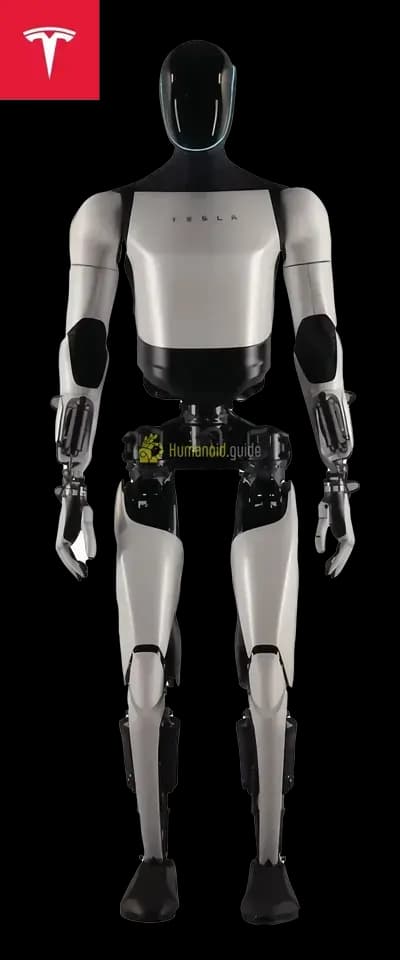
Image : Wikimedia Commons (public domain)
En développement🇺🇸 USA
Optimus Gen 2
par Tesla · humanoid · Annoncé 2022
$20,000–$30,000 target at scale; not for sale, no MSRP. Optimus V3 not unveiled as of Sep 2026; Fremont line being installed, production expected later in 2026 (Q2 2026 update)
Tesla's bipedal humanoid designed for autonomous factory tasks, leveraging FSD neural networks and manufactured entirely in-house.
Aperçu
Le Optimus Gen 2 est un humanoid développé par Tesla (USA), annoncé en 2022. Actuellement en développement. Avec 168 cm de haut, 57 kg, 28 degrés de liberté, peut transporter des charges jusqu'à 20 kg. Points forts : vitesse maximale de 2.2 m/s, autonomie de 480 minutes, batterie de 2300 Wh. La plateforme offre processeur Tesla FSD custom SoC, équipé de 8x cameras (Autopilot-heritage), tactile fingertip sensors, force/torque joints, IMU.
Optimus Gen 2 — use cases
Tri de cellules de batterie à l'usine Tesla de Fremont
Tesla a montré Optimus Gen 2 en train de trier des cellules 4680 dans des plateaux à l'usine de Fremont. La tâche s'appuie sur les mains à 11 degrés de liberté et les capteurs tactiles au bout des doigts pour déterminer l'orientation des cellules. Tesla n'a publié ni temps de cycle ni taux de précision, mais a décrit le flux de travail lors de la conférence de résultats du troisième trimestre 2024 et dans les vidéos suivantes.
Manutention de pièces sur la ligne Cybertruck
La vidéo de présentation de décembre 2023 montrait Gen 2 circulant dans la zone de production du Cybertruck à Fremont. Les tâches rapportées comprennent le déplacement de petits composants entre postes et des opérations de rangement. La charge utile nominale de 20 kg (chiffre Tesla) couvre l'essentiel des mouvements de petites pièces en bord de ligne, mais exclut les ensembles de transmission et les packs de batterie complets.
Contrôle qualité des pièces de fonderie structurelles
Plusieurs vidéos Tesla diffusées en 2025 montraient des unités Gen 2 positionnées près des mégapièces moulées, où les huit caméras héritées d'Autopilot exécutent des routines d'inspection visuelle. La cadence par équipe n'a pas été divulguée et Tesla n'a pas précisé si des inspecteurs humains vérifient encore les résultats.
Démonstrations de gymnastique et d'équilibre
Tesla a publié des séquences où Gen 2 effectue des squats à profondeur maîtrisée et soulève un œuf sans en briser la coquille. Ce sont des démonstrations scénarisées, pas des flux de production : elles illustrent les actionneurs à contrôle de couple et les doigts articulés, non un déploiement commercial.
Collecte de données internes pour l'entraînement de Gen 3
Lors de la conférence de résultats du quatrième trimestre 2025 (28 janvier 2026), Tesla a fait état d'environ 300 unités Optimus déployées dans ses propres usines. Elon Musk a décrit cette flotte comme une phase d'apprentissage : les robots génèrent des traces de téléopération et des journaux d'échecs autonomes qui alimentent la pile d'entraînement de Gen 3. De l'aveu même de Tesla, ils n'exécutent pas encore de tâches productives avec une fiabilité de niveau industriel.
Version history
Optimus Gen 1 (prototype Bumble C) — 30 septembre 2022
Tesla a dévoilé le premier prototype marchant lors de l'AI Day 2. Les premières démonstrations utilisaient des actionneurs du commerce, la solution conçue par Tesla étant présentée à l'arrêt. Le poids avoisinait 73 kg. Le robot a marché sans assistance pendant quelques minutes sur scène.
Optimus Gen 2 — 12 décembre 2023
Chaîne d'actionneurs entièrement conçue par Tesla, 10 kg de moins que Gen 1, démarche 30 % plus rapide, mains à 11 degrés de liberté en remplacement des 6 précédents, cou motorisé à 2 degrés de liberté, orteils articulés et capteurs tactiles au bout des doigts. Le système de vision à huit caméras réutilise une partie de la chaîne de traitement d'Autopilot.
Révision de la main Gen 2 (« v2.5 ») — Mi-2024 (Tesla n'a pas donné de date précise)
Tesla a présenté mi-2024 une main revue passant de 11 à 22 degrés de liberté. Cette main améliorée est d'abord apparue sur des unités de démonstration internes avant d'être intégrée aux spécifications de série de Gen 3.
Optimus Gen 3 — Début de production le 21 janvier 2026 à Fremont
Première conception de Tesla destinée à la production de masse. Selon le rapport du quatrième trimestre 2025, environ 300 unités ont été construites, principalement pour l'apprentissage interne. Tesla n'a pas publié la fiche technique complète de Gen 3. Les déclarations publiques évoquent des mains à plus de degrés de liberté, un ensemble d'actionneurs redessiné et une informatique embarquée dérivée du FSD. D'après les chiffres avancés par Musk au CES 2025, l'objectif pour fin 2026 se situe entre 50 000 et 100 000 unités.
Deployment evidence
Tesla Fremont, Californie
Premier site documenté de déploiement d'Optimus. Depuis la mi-2024, les tâches couvrent le tri de cellules, la manutention de pièces et le contrôle qualité des pièces de fonderie. Depuis janvier 2026, Fremont est également le site de production des unités Gen 3.
Source: Commentaires Tesla des résultats du T3 2024 et du T4 2025
Tesla Giga Texas, Austin
Deuxième site de déploiement depuis 2024. Les vidéos de Tesla y montrent la même combinaison de tâches qu'à Fremont. Giga Texas doit aussi accueillir une usine dédiée à Optimus visant 10 millions d'unités par an, les premières lignes étant annoncées pour 2027 selon les déclarations publiques de Tesla.
Source: Documents investisseurs Tesla, 2025
Clients externes
Tesla n'a divulgué aucun déploiement de Gen 2 chez un client externe. Le robot reste une flotte interne. La première livraison externe évoquée par Tesla vise une disponibilité grand public vers fin 2027, associée à du matériel dérivé de Gen 3.
Known limitations
Plateforme logicielle fermée
Optimus fonctionne sur la pile propriétaire de Tesla. Aucune prise en charge de ROS ou ROS 2, aucun SDK publié, aucun écosystème applicatif tiers. Les chercheurs et intégrateurs souhaitant étendre le comportement d'un humanoïde se tournent vers des plateformes comme Unitree H1 ou Boston Dynamics Atlas Research.
L'autonomie annoncée est une valeur constructeur
Les 480 minutes annoncées par Tesla correspondent à un fonctionnement au repos ou en charge légère. Tesla n'a pas publié de tableau de cycle de service couvrant la charge utile, le temps de marche ou la sollicitation des mains. En manutention continue, l'autonomie réelle sera plus faible, sans que l'écart soit connu.
Aucune donnée de fiabilité publiée
Tesla n'a communiqué ni temps moyen entre pannes, ni données d'usure des articulations, ni taux de disponibilité de la flotte déployée. Sans cela, les affirmations de Tesla sur le coût total de possession ne peuvent être confrontées aux divulgations habituelles de la robotique industrielle.
Charge utile d'apparence prudente mais non vérifiée
Les 20 kg annoncés placent Gen 2 sous Figure 02 (25 kg) et au niveau d'Agility Digit (environ 16 kg). Tesla n'a publié ni cycle de service, ni arc de levage, ni enveloppe de centre de masse permettant de soutenir ces 20 kg ; le chiffre n'est donc pas directement comparable aux fiches techniques d'humanoïdes industriels qui précisent ces conditions.
Perception uniquement visuelle, sans LiDAR
Tesla a étendu à Optimus la philosophie « caméras seules » d'Autopilot. Il n'y a ni LiDAR ni capteur de profondeur à lumière structurée. Sous un éclairage d'usine peu contrasté et sur des surfaces métalliques réfléchissantes, les piles purement visuelles présentent des modes de dégradation connus que Tesla n'a pas abordés publiquement dans le contexte humanoïde.
How Optimus Gen 2 compares
vs. Figure 02
Du point de vue du déploiement, Figure 02 (Figure AI) est le concurrent le plus direct sur le marché américain. Figure a confirmé un déploiement commercial rémunéré chez BMW à Spartanburg, alors que Tesla ne dispose que d'une flotte interne. Figure 02 utilise deux modules GPU NVIDIA RTX là où Tesla emploie un SoC maison dérivé du FSD, et annonce une charge utile supérieure : 25 kg contre 20 kg. En revanche, Figure marche plus lentement (1,2 m/s contre 2,2 m/s annoncés par Tesla) et affiche une autonomie plus courte (300 minutes contre 480). Figure 02 coûterait entre 130 000 et 150 000 dollars en version entreprise ; Tesla n'a évoqué qu'un objectif grand public à long terme de 20 000 dollars.
vs. Boston Dynamics Atlas (électrique)
Boston Dynamics a retiré l'Atlas hydraulique en avril 2024 et l'a remplacé par la version électrique destinée au déploiement commercial. Atlas Electric a été démontré dans des sites du groupe Hyundai. Face à Optimus Gen 2, Atlas Electric apporte vingt ans de recherche en contrôle de la locomotion et la bibliothèque de démarches publiée la plus mature du secteur. En contrepartie : un coût plus élevé, une pile logicielle opaque et une orientation vers la manipulation dynamique plutôt que vers la manutention de pièces en grande série pour laquelle Tesla optimise.
vs. Unitree H1
Unitree H1 se situe sur un autre segment de prix (environ 90 000 dollars catalogue) et est livré avec la prise en charge de ROS 2 et un accès développeur ouvert. C'est le choix pragmatique pour les laboratoires universitaires et les intégrateurs qui ont besoin d'une plateforme bipède opérationnelle aujourd'hui. L'Optimus Gen 2 de Tesla n'a ni prix public, ni SDK, et n'est pas en vente. La charge utile d'Unitree (environ 15 kg) et son autonomie restent en deçà des chiffres de Tesla, mais l'ouverture de la plateforme est précisément l'argument auquel Tesla ne répond pas.
Caractéristiques
Taille
168 cm
Poids
57 kg
DDL
28
Charge utile
20 kg
Autonomie
8h
Vitesse max.
2.2 m/s
Batterie
2300 Wh
Temps de charge
—
Escaliers
Oui
LiDAR
Non
Calcul
Tesla FSD custom SoC
ROS
Aucun
Plateforme
Capteurs
8x cameras (Autopilot-heritage)tactile fingertip sensorsforce/torque jointsIMU
Système d'exploitation
Proprietary
Dernière mise à jour: 2026-09-26 · Annoncé 2022
Sources
- tesla.com/optimusvérifié 2026-09-26
- en.wikipedia.org/wiki/Optimus_(robot)2026-09-24
- theroboticlife.com/robot-of-the-week-tesla-optimus-gen-3vérifié 2026-09-26
- electrek.co/2026/04/22/tesla-optimus-production-fremont-model-sx-linevérifié 2026-09-26
FAQ
Q.Quel est le prix du Optimus Gen 2 ?
Le prix du Optimus Gen 2 n'a pas encore été officiellement annoncé.
Q.Quelles sont les caractéristiques du Optimus Gen 2 ?
Le Optimus Gen 2 dispose de : 28 DOF, 168cm, 57kg, 20kg payload, 480 min runtime. Tesla FSD custom SoC, no ROS.
Q.Le Optimus Gen 2 est-il disponible à l'achat ?
Le Optimus Gen 2 est actuellement en développement et n'est pas encore disponible à l'achat.
Q.Who makes Optimus Gen 2?
Optimus Gen 2 is made by Tesla, headquartered in USA. Official manufacturer site: https://www.tesla.com/optimus.
Q.Does Optimus Gen 2 support ROS?
Optimus Gen 2 does not list official ROS support. Tesla ships Optimus Gen 2 with a proprietary software stack; third-party ROS integration is not officially endorsed.
Q.How long does the Optimus Gen 2 battery last?
Optimus Gen 2 runs for approximately 8h on a single charge (battery capacity: 2300 Wh).
Q.What payload can Optimus Gen 2 carry?
Optimus Gen 2 is rated to carry up to 20 kg of payload, suitable for industrial logistics and warehouse workloads.
Q.How fast is Optimus Gen 2?
Optimus Gen 2 has a published maximum walking speed of 2.2 m/s and can navigate stairs.
Q.What are alternatives to Optimus Gen 2?
Closest specs-wise alternatives to Optimus Gen 2 include H1-2 by Unitree Robotics, Figure 02 by Figure AI, Digit by Agility Robotics (Amazon). Full head-to-head comparison: https://biorobot.ai/fr/vs/tesla-optimus-gen2-vs-unitree-h1-2.
Comparer Optimus Gen 2
Optimus Gen 2 vs H1-2Unitree RoboticsOptimus Gen 2 vs Figure 02Figure AIOptimus Gen 2 vs DigitAgility Robotics (Amazon)Optimus Gen 2 vs Figure 03Figure AI
All 42 comparisons with Optimus Gen 2
Optimus Gen 2 vs 4NE-1Optimus Gen 2 vs A2Optimus Gen 2 vs ApolloOptimus Gen 2 vs ASIMOOptimus Gen 2 vs Astribot S1Optimus Gen 2 vs Atlas (Electric)Optimus Gen 2 vs CL-1Optimus Gen 2 vs CyberOneOptimus Gen 2 vs DigitOptimus Gen 2 vs DR02Optimus Gen 2 vs EVEOptimus Gen 2 vs Figure 02Optimus Gen 2 vs Figure 03Optimus Gen 2 vs Forerunner K1Optimus Gen 2 vs Forerunner K2Optimus Gen 2 vs G1Optimus Gen 2 vs G1Optimus Gen 2 vs GR-1Optimus Gen 2 vs GR-2Optimus Gen 2 vs H1Optimus Gen 2 vs H1-2Optimus Gen 2 vs H2Optimus Gen 2 vs Kaleido 9Optimus Gen 2 vs L7Optimus Gen 2 vs MenteeBot V3Optimus Gen 2 vs MirokaiOptimus Gen 2 vs NAO V6Optimus Gen 2 vs NEOOptimus Gen 2 vs Optimus Gen 3Optimus Gen 2 vs PepperOptimus Gen 2 vs PhoenixOptimus Gen 2 vs PM01Optimus Gen 2 vs R1Optimus Gen 2 vs RAISE A1Optimus Gen 2 vs Reachy 2Optimus Gen 2 vs SE01Optimus Gen 2 vs SophiaOptimus Gen 2 vs T-HR3Optimus Gen 2 vs T1Optimus Gen 2 vs TALOSOptimus Gen 2 vs Walker SOptimus Gen 2 vs Walker S2