Optimus Gen 2 vs Atlas (Electric): Specs, Price & ROS Support Compared (2026)
Tesla vs Boston Dynamics (Hyundai) — independent, side-by-side analysis.
Quick Verdict
Optimus Gen 2 leads in longer runtime, while Atlas (Electric) leads in more DOF, higher payload. Overall, Atlas (Electric) has an edge in 2 out of 3 compared categories.

Optimus Gen 2
Tesla
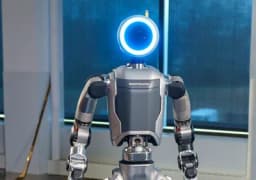
Atlas (Electric)
Boston Dynamics (Hyundai)
DNA Fingerprint Overlay
Optimus Gen 2 Atlas (Electric)
Specifications
$20,000–$30,000 target at scale; not for sale, no MSRP. Optimus V3 not unveiled as of Sep 2026; Fremont line being installed, production expected later in 2026 (Q2 2026 update)Price~$420,000 (enterprise estimate). Not sold openly: early deployments with select customers; Atlas training center at Hyundai Metaplant Georgia operating since Sep 2026, Hyundai plans 25,000 units
168 cmHeight190 cm
57 kgWeight90 kg
28DOF56
20 kgPayload30 kg
8hRuntime4h
2.2 m/sSpeed—
YesStairsYes
NoLiDARYes
Tesla FSD custom SoCComputeNVIDIA Jetson Thor
Task Capabilities
✓Pick up a box from shelf?
◔Open a door handle?
◔Pour liquid into cup?
◔Use a power tool?
✕Type on keyboard?
✓Climb stairs with load?
◔Walk on uneven terrain?
✕Run (>3 m/s)?
◔Crouch under obstacle?
◔Navigate in crowd?
✓Recognize & locate objects?
◔Respond to voice commands?
✓Detect humans nearby?
✓Work 8-hour shift?
✕Hot-swap battery?
◔Operate 24/7 (with charging)?
✕Work in rain (IP65+)?
?Work below 0°C?
?Work in dusty environment?
◔Work safely alongside humans?
Ecosystem Openness
5
Optimus Gen 2
/100
25
Atlas (Electric)
Fully proprietary. No public SDK/API. Closed ecosystem.
NVIDIA Isaac (ROS2) but limited public access. Mostly enterprise.
Pros and cons at a glance
Optimus Gen 2
Pros
- Long runtime (8h per charge) for full-shift operation
- 28 degrees of freedom — full-body articulation
Cons
- Still in development, no commercial availability
- Unit price not publicly disclosed (quote-on-request or enterprise-only)
- Closed software stack — no public SDK or ROS support
Atlas (Electric)
Pros
- Shipping to customers (verified commercial availability)
- High rated payload (30 kg) for industrial pick-and-place
- Ships with LiDAR for robust depth sensing in low-light environments
- 56 degrees of freedom — full-body articulation
Cons
- Unit price not publicly disclosed (quote-on-request or enterprise-only)
Frequently asked questions
How do Optimus Gen 2 and Atlas (Electric) compare on price?
Optimus Gen 2: $20,000–$30,000 target at scale; not for sale, no MSRP. Optimus V3 not unveiled as of Sep 2026; Fremont line being installed, production expected later in 2026 (Q2 2026 update). Atlas (Electric): ~$420,000 (enterprise estimate). Not sold openly: early deployments with select customers; Atlas training center at Hyundai Metaplant Georgia operating since Sep 2026, Hyundai plans 25,000 units.
Which has higher payload: Optimus Gen 2 or Atlas (Electric)?
Atlas (Electric) rates a higher payload at 30 kg vs 20 kg. Payload ratings are vendor claims and do not always include a duty cycle — peak vs sustained payload can differ significantly.
Is Optimus Gen 2 or Atlas (Electric) actually available to buy?
Optimus Gen 2 is in active development without commercial availability. Atlas (Electric) is shipping to customers. Status reflects the vendor's published commercial position as of the last review and can change between announcement and actual delivery.
Which is better for ROS-based development: Optimus Gen 2 or Atlas (Electric)?
Optimus Gen 2 has no ROS support; Atlas (Electric) has ros2. For research and multi-vendor robotics stacks, native ROS 2 is the strongest signal of ecosystem maturity.
Does Optimus Gen 2 or Atlas (Electric) use LiDAR?
Atlas (Electric) ships with LiDAR for depth sensing; Optimus Gen 2 does not. LiDAR adds cost and complexity but improves obstacle detection in low-light or low-contrast environments.
Last updated: 2026
Related Comparisons
Optimus Gen 2 vs Forerunner K1Kepler RoboticsAtlas (Electric) vs Forerunner K1Kepler RoboticsOptimus Gen 2 vs MenteeBot V3Mentee RoboticsAtlas (Electric) vs MenteeBot V3Mentee RoboticsOptimus Gen 2 vs PhoenixSanctuary AIAtlas (Electric) vs PhoenixSanctuary AIOptimus Gen 2 vs Optimus Gen 3TeslaAtlas (Electric) vs Optimus Gen 3Tesla