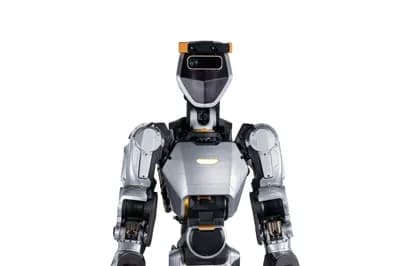
Development🇨🇦 Canada
Phoenix
by Sanctuary AI · humanoid · Announced 2023
Contact (enterprise). Phoenix Gen 8 still in development; since mid-2026 Sanctuary also sells its Carbon control software on third-party industrial robots
Vancouver-built general-purpose humanoid with 21-DOF hydraulic hands and the Carbon AI control stack. First commercial deployment announced March 2026; roughly 50 units deployed, none available for purchase.
Overview
The Phoenix is a humanoid developed by Sanctuary AI (Canada), first announced in 2023. It is currently in development. Standing 170 cm tall, weighing 70 kg, with 41 degrees of freedom, it can carry payloads up to 25 kg. Performance highlights include a top speed of 0.83 m/s. The platform is powered by Carbon AI system (Microsoft Azure), equipped with RGB cameras, micro cameras, tactile sensors (7-cell, 5mN resolution), IMU, and 2 more sensor types.
Phoenix — use cases
Retail back-of-house pilot
In April 2023 Sanctuary AI ran a one-week deployment with Canadian Tire in Langley, British Columbia. Phoenix ran 110 discrete tasks during the pilot, including picking, packing, tagging, folding, cleaning, labeling, and receiving. Sanctuary framed the pilot as a proof point for general-purpose task variety rather than a per-task throughput demonstration, and did not publish success rates or completion times for individual task categories.
Automotive parts manufacturing
In October 2024 Sanctuary announced a commercial partnership with Magna International, one of the largest automotive suppliers in North America, to deploy Phoenix on manufacturing lines. The initial scope covers material handling and sub-assembly tasks in Magna facilities. Sanctuary has not disclosed the number of units placed, the specific plant locations, or the task list under the Magna program.
Hydraulic-hand tactile manipulation
Phoenix carries hydraulic hands rated at 5 millinewton (mN) tactile sensitivity — roughly one-tenth the force of holding a raisin. Each hand carries seven tactile cells. Sanctuary positions the hand as the platform's core differentiator for tasks that require sub-gram grip modulation, such as textile handling, small-parts sub-assembly, and food-adjacent packaging. The 41 total degrees of freedom are heavily concentrated in the hands, which is where the majority of the platform's engineering investment sits.
Carbon AI as the training substrate
Sanctuary runs its Carbon AI cognitive architecture on Microsoft Azure infrastructure. Carbon combines symbolic reasoning with learned components; Sanctuary has stated that pilot deployments feed data back into Carbon for continued training. The Azure integration was announced in a 2023 partnership disclosure. Sanctuary has not published Carbon's model size, training corpus size, or independent benchmark results.
Enterprise-only market posture
Sanctuary sells Phoenix into enterprise pilots and partnerships rather than through a published price list. The stated pricing model is contact-only. This maps to a slow-rollout strategy focused on multi-quarter partnerships (Canadian Tire, Magna) rather than volume shipment. Sanctuary has not disclosed a public unit-count target or a shipping year for a commercial product line.
Version history
Sanctuary Cognitive Systems, early Delta prototypes — 2018-2022
Sanctuary AI was founded in 2018 in Vancouver, Canada by Geordie Rose (co-founder of D-Wave Systems and Kindred), Suzanne Gildert, and Olivia Norton. Early prototypes were mobile manipulator platforms under the internal Delta name, focused on teleoperation training data collection. These platforms were not commercial products; Sanctuary used them internally to build the Carbon AI training corpus.
Phoenix Gen 6 — May 2023
First public Phoenix reveal. 170 cm, 70 kg, 20 degrees of freedom in each hand. Sanctuary positioned Gen 6 as the first version intended for external pilots, and the Canadian Tire deployment followed within weeks. Sanctuary did not publish full spec sheets for Gen 6 at the time of reveal; several numbers appeared only in subsequent press coverage.
Phoenix Gen 7 — April 2024
Sanctuary announced Gen 7 with reduced hardware cost, longer runtime versus Gen 6 (specific figures not published), and improved uptime. Gen 7 kept the 41-DoF profile and the hydraulic hand architecture. Sanctuary described Gen 7 as an internal-development platform used to reduce build cost ahead of a commercial rollout, not as a customer-shipping generation.
Magna partnership announcement — October 2024
First named commercial partnership. Sanctuary and Magna International announced Phoenix deployment on Magna manufacturing lines. The announcement did not commit to a specific unit count, deployment date, or contract length. Sanctuary framed the partnership as a scaling milestone rather than a shipment.
Ongoing development status — Through 2026
Sanctuary's status remains 'development' rather than 'shipping' in its own materials. Financing continues (multiple rounds through 2023-2024 including funding from Bell Canada, InBC, and the Canadian federal Strategic Innovation Fund). Sanctuary has not published a target date for the shift from pilot deployments to a commercially available product with a price and lead time.
Deployment evidence
Canadian Tire, Langley, British Columbia
One-week pilot in April 2023 covering 110 tasks across picking, packing, tagging, folding, cleaning, labeling, and receiving. This is the most publicly documented Phoenix deployment. Sanctuary published a follow-up video and blog post; no formal per-task success-rate report was released.
Source: Sanctuary AI, Canadian Tire Phoenix Pilot, 2023
Magna International manufacturing facilities
Announced October 2024. Phoenix deployment on Magna manufacturing lines for material handling and sub-assembly. Sanctuary has not disclosed the specific plants, unit counts, or timeline; Magna has stated only that the partnership is 'commercial' in nature.
Source: Sanctuary AI, Magna Partnership Announcement, October 2024
Vancouver, BC — Sanctuary AI headquarters
Sanctuary operates its primary engineering and manufacturing facility in Vancouver. Internal Phoenix units run there for development, teleoperation data collection, and Carbon AI training. This is a first-party site rather than a customer deployment.
Known limitations
Not shipping — status remains 'development'
Sanctuary categorizes Phoenix as a development platform, not a shipping product. There is no public price, no published lead time, and no order book. Enterprise engagement runs through direct partnership discussions. A buyer looking to deploy in 2026 cannot get Phoenix on a purchase order or a lease contract without a bilateral partnership agreement.
Undisclosed battery specification
Sanctuary has not published battery capacity in kWh, runtime, or charge time for Phoenix. Public materials describe hardware improvements between Gen 6 and Gen 7 that include runtime gains, but the underlying numbers have not been released. A duty-cycle analysis against competitors (Apollo, Digit, Figure 02) is not possible from public data.
Slow maximum walking speed
Phoenix rates 0.83 m/s maximum walking speed — under 3 km/h. This is below Agility Digit (roughly 1.6 m/s), Figure 02, and Apptronik Apollo. For deployments that require moving between task stations across a large floor, Phoenix loses time in transit. Sanctuary has not published a running mode or a faster-walking configuration.
No ROS or ROS 2 support, no public SDK
Phoenix runs on Carbon AI, a proprietary stack integrated with Microsoft Azure. There is no public ROS bridge, no published SDK, and no third-party developer program. Research groups and integrators that want open middleware stay on Digit, Unitree platforms, or Boston Dynamics Atlas Research. Sanctuary has not stated whether a developer program is planned.
Hydraulic hands add maintenance surface
The hydraulic hand design that gives Phoenix its 5 mN tactile resolution also introduces maintenance considerations that competitor tendon-driven or geared hands do not carry — hydraulic fluid, seals, and pressure lines. Sanctuary has not published mean-time-between-service figures for the hands or a field-serviceability plan. In pilot contexts this is not visible; at scale it becomes a component of total cost of ownership.
How Phoenix compares
vs. Apptronik Apollo
Apollo is Phoenix's closest peer by mission: enterprise general-purpose humanoid, similar height (Apollo 173 cm vs Phoenix 170 cm), similar weight (Apollo 72.6 kg vs Phoenix 70 kg), same 25 kg payload rating. The split is deployment maturity. Apollo has publicly named partnerships with Mercedes-Benz and GXO Logistics with unit counts and pilot pricing on the record. Phoenix has Canadian Tire (2023 one-week pilot) and Magna (2024 partnership announcement) with no unit counts disclosed. Apollo runs modular battery swap and quotes runtime; Phoenix does not publish battery specifications. On hand design, Phoenix's hydraulic 5 mN tactile hand is more sensitive than Apollo's electric hand, but Apollo's shipping cadence is ahead. For a buyer choosing today, Apollo is the more procurable platform; Phoenix is the platform with the more distinctive manipulation capability.
vs. Figure 02
Figure 02 shares the enterprise-humanoid segment with Phoenix but sits in a different funding and shipping stage. Figure 02 stands at 168 cm and 70 kg — nearly identical body dimensions to Phoenix — with 25 kg payload, 300-minute runtime, and BMW Spartanburg as a named deployment. Figure 02 runs Helix VLA (Figure's in-house model) versus Sanctuary's Carbon AI. Figure ships hardware and has published production data; Sanctuary has not moved out of the development category. The distinguishing spec on Phoenix is the hydraulic tactile hand — Figure 02 uses a 16-DoF electric hand with different tactile characteristics. Figure has priced its next-generation platform (Figure 03) around $20,000 for a home variant; Sanctuary has no public price at any tier.
vs. Agility Digit
Digit is the enterprise-humanoid comparison for logistics workloads. Digit stands at 175 cm and 65 kg, walks at roughly 1.6 m/s (nearly double Phoenix's 0.83 m/s), and rates 16 kg payload against Phoenix's 25 kg. Digit ships under Robots-as-a-Service contracts (GXO Logistics is the named large-scale customer) with pricing on the record around $30 per operating hour. Digit has ROS 2 support and an Arc cloud SDK; Phoenix has neither. Digit's manipulator is simpler than Phoenix's hydraulic hand — Digit's grippers are optimized for tote handling rather than sub-gram tactile work. The two platforms compete for adjacent but distinct use cases: Digit for volume tote movement, Phoenix for precision manipulation. A warehouse tote line favors Digit; a small-parts sub-assembly cell that requires 5 mN grip modulation favors Phoenix — if Phoenix is available.
Specifications
Height
170 cm
Weight
70 kg
DOF
41
Payload
25 kg
Runtime
—
Max Speed
0.83 m/s
Battery
—
Charge Time
—
Stairs
Yes
LiDAR
No
Compute
Carbon AI system (Microsoft Azure)
ROS
None
Platform
Sensors
RGB camerasmicro camerastactile sensors (7-cell, 5mN resolution)IMUgyroscopetemperature sensors
Operating System
Carbon AI (proprietary)
Last updated: 2026-09-26 · Announced 2023
Sources
FAQ
Q.What is the price of Phoenix?
The Phoenix price has not been officially announced yet.
Q.What are the specs of Phoenix?
Phoenix features 41 DOF, 170cm, 70kg, 25kg payload, N/A. Carbon AI system (Microsoft Azure), no ROS.
Q.Is Phoenix available to buy?
Phoenix is currently in development and not yet available for purchase.
Q.Who makes Phoenix?
Phoenix is made by Sanctuary AI, headquartered in Canada. Official manufacturer site: https://www.sanctuary.ai.
Q.Does Phoenix support ROS?
Phoenix does not list official ROS support. Sanctuary AI ships Phoenix with a proprietary software stack; third-party ROS integration is not officially endorsed.
Q.What payload can Phoenix carry?
Phoenix is rated to carry up to 25 kg of payload, suitable for industrial logistics and warehouse workloads.
Q.How fast is Phoenix?
Phoenix has a published maximum walking speed of 0.83 m/s and can navigate stairs.
Q.What are alternatives to Phoenix?
Closest specs-wise alternatives to Phoenix include MenteeBot V3 by Mentee Robotics, Forerunner K1 by Kepler Robotics, Optimus Gen 3 by Tesla. Full head-to-head comparison: https://biorobot.ai/en/vs/sanctuary-phoenix-vs-menteebot-v3.
Compare Phoenix
Phoenix vs MenteeBot V3Mentee RoboticsPhoenix vs Forerunner K1Kepler RoboticsPhoenix vs Optimus Gen 3TeslaPhoenix vs Figure 03Figure AI
All 42 comparisons with Phoenix
Phoenix vs 4NE-1Phoenix vs A2Phoenix vs ApolloPhoenix vs ASIMOPhoenix vs Astribot S1Phoenix vs Atlas (Electric)Phoenix vs CL-1Phoenix vs CyberOnePhoenix vs DigitPhoenix vs DR02Phoenix vs EVEPhoenix vs Figure 02Phoenix vs Figure 03Phoenix vs Forerunner K1Phoenix vs Forerunner K2Phoenix vs G1Phoenix vs G1Phoenix vs GR-1Phoenix vs GR-2Phoenix vs H1Phoenix vs H1-2Phoenix vs H2Phoenix vs Kaleido 9Phoenix vs L7Phoenix vs MenteeBot V3Phoenix vs MirokaiPhoenix vs NAO V6Phoenix vs NEOPhoenix vs Optimus Gen 2Phoenix vs Optimus Gen 3Phoenix vs PepperPhoenix vs PM01Phoenix vs R1Phoenix vs RAISE A1Phoenix vs Reachy 2Phoenix vs SE01Phoenix vs SophiaPhoenix vs T-HR3Phoenix vs T1Phoenix vs TALOSPhoenix vs Walker SPhoenix vs Walker S2